by Abi Hackett
“Only if words are felt, bodily presences, like echoes or waterfalls, can we understand the power of spoken language to influence, alter and transform the world.” (Abram, 1997, p.89)
In our final workshop of the project, we invited participants to approach toddler’s language differently. In a context where toddler language is loaded with expectations, anxiety, and preferred developmental trajectories, we instead spent the day focussing on how language feels, how it connects us to others and to aspects of our identities and how it can transport us to imaginative spaces and different times.
Beyond a way of sharing information, language is something we feel in our bodies, and language affects our bodies. This comes down to vibrational sound, as it issues from bodies, via breathe, mouths, throats, tongues. We wanted to think about how toddlers’ language feels for them, how it makes us feel, and how those feelings come about through vibrational movement and sound. It can be a challenging task to disrupt our assumptions and habitual ways of thinking about language. In order to listen differently, and try to attune to parts of language that we might sometimes struggle to notice, our morning began with a series of exercises to tune into vibrational and felt aspects of language.
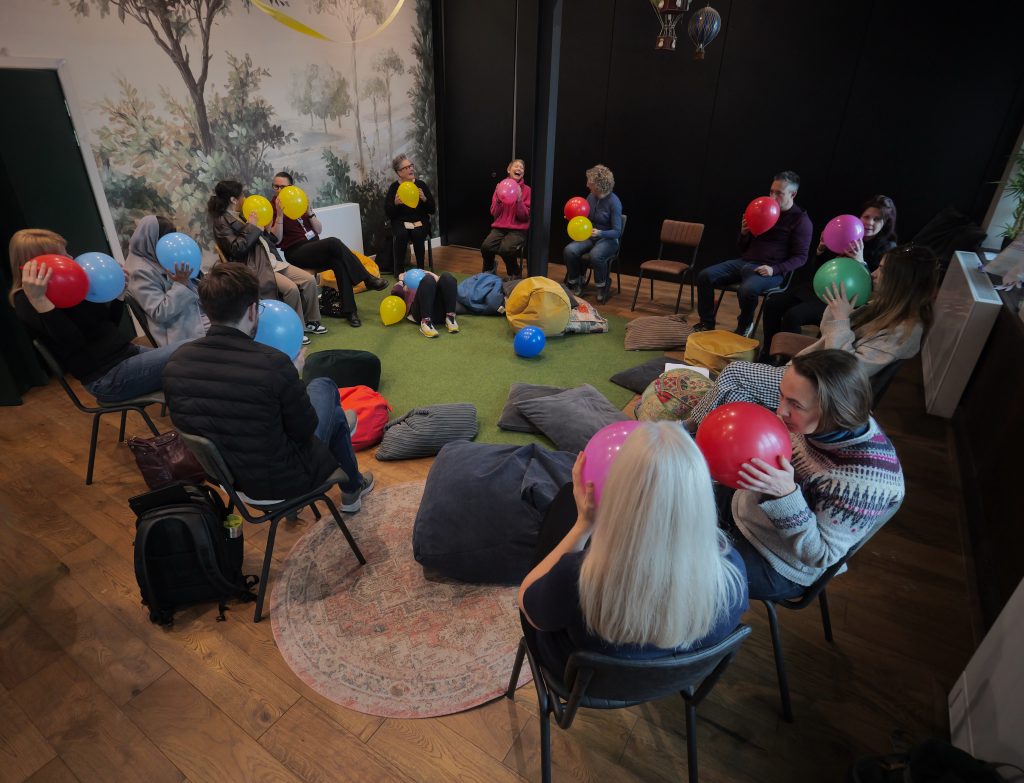
Firstly, we took part in a playful experiment with balloons, trying to find different ways to physically feel the vibrational qualities of sound. Experimenting with body position, balloon position, different surfaces around the room, and different vocalisations, we listened to and noticed reverberations, the transference of sounds and the tingling vibrations in skin resting on the balloon surface.
Language, we proposed, depends on both sounding and listening, and the dynamic between the two. To interrogate this, we took part in a deep listening activity in small groups, taking it in turns to be the ‘listener’, who sits in the centre of the room with eyes covered or closed, and the ‘sound makers’ who choose materials, surfaces or their own body movements to create a soundscape. Deep listening is a tradition that involves resisting (over) thinking and interpreting whilst listening, maintaining instead an openness to what occurs. We pondered as a group what the implications of this might be in relation to listening, sounding and young children.
From this perspective, we brought our focus back more explicitly to young children’s language. Ruth Levene provided a series of three audio and video pieces, which we listened to on headphones in sequence. Each offered fine grained fragments of a tiny encounter between a toddler, Ruth, and a garden bed of dirt and plants. Reflected on each of these pieces in turn, perhaps we arrived from a different angle, with a different set of assumptions or things we might be noticing.
Through these different experiences, our aim was to make noticeable our habit of wanting to make sense of what we hear and see when it comes to young children’s language. Whilst this is understandable, but perhaps it causes us to jump to conclusions, to notice the aspects of the sound and movement that are easiest to make sense of, and to overlook other aspects as “meaningless”, particularly the way language feels and the way it connects us and brings us into relation with others and with the world.
After lunch, we took these ideas forward as we engaged with a piece of work Vilk Collective had created in collaboration with a local playgroup, run by a charity for refugee families and those seeking asylum. The work involved a series of audio pieces that we listened to sequentially – a mix of multilingual lullabies provided by mothers from the playgroup, exerts from interviews with families and the playgroup organiser talking about language as multilingual and entangled with identity, and evocative soundscapes of the playgroup itself, in which the sounds of movement, playing, adult chat, toddler vocalisation and singing intermingle. We listened to this work on the headphones again, and discussed in small grounds. Because several families from the playgroup had joined us by then, this worked particularly well because children as well as adults could wear the headphones, and parents could move around with their children whilst listening and participating.
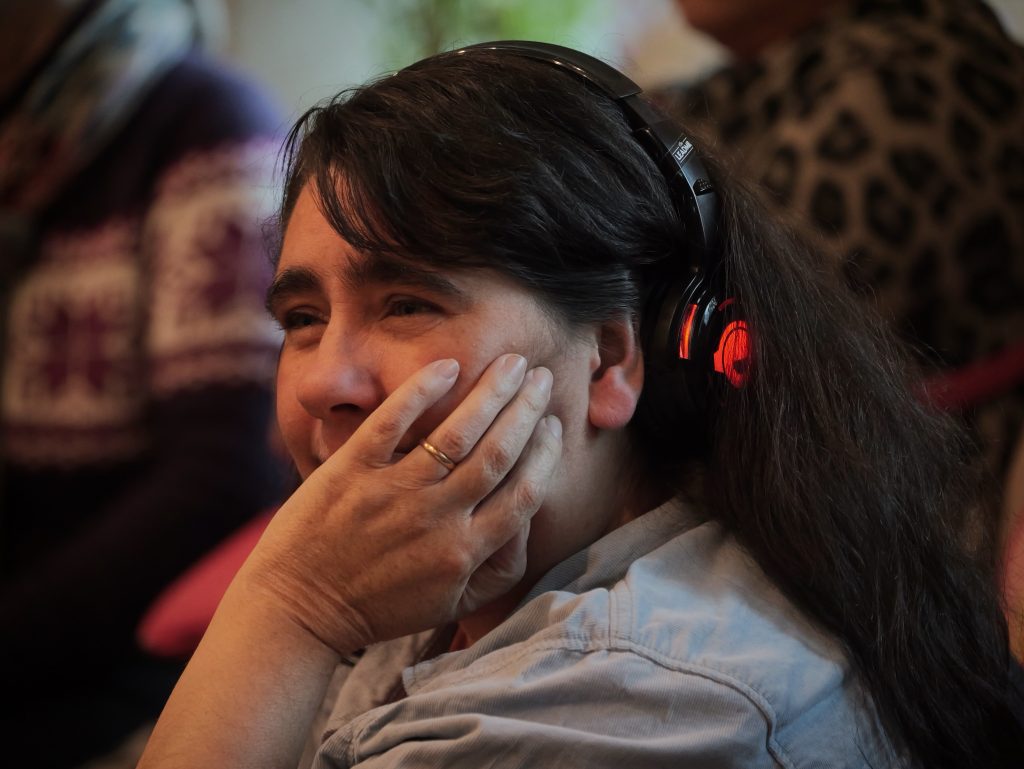
This work was deeply moving, and brought the emotional, felt and relational aspects of family language practices into sharp relief, alongside the effort parents often put in to raising children with multiple languages. In dominant accounts of language and early childhood education, there is often an emphasis on language as something that helps children become more independent. However, language is relational – it depends on both the speaker(s) and the listener(s) and what happens between and amongst us. In this sense, language always depends on others. Therefore, we wondered – what if the aim of language was to strengthen and deepen interdependency instead of independence?
“As children [we enter language] by actively making sounds – by crying in pain and laughing in joy, by squealing and babbling and playfully mimicking the soundscape. We thus learn our native language not mentally but bodily” (Abram, 1997, p.75)
David Abram’s account of language a ‘vocal gesticulation’ offers a counter narrative of early language as relying primarily on movement, experimentation, place and others. This offers us, as adults, a different way to engage and respond – to enter into movement and relation perhaps with children, even when we are not sure what the words mean, or we do not share the same language. To think perhaps, of language as musical, vibrational, and bodily, as well as a mode of communication. Throughout Towards Toddlerhood, our workshops have not offered neat answers, but instead an invitation to notice otherwise. At the end of the workshop, each participant left with a small red notebook, embossed with this invitation to notice otherwise, and the proposition that noticing itself, in its tiny-ness and humility, can be a radical act towards a more artful toddlerhood.
Reference
Abram, D. (1996). The spell of the sensuous. New York: Vintage Books.