By Ruth Boycott Garnett and Kitty Winter
‘Oh the summer was long and the autumn too,
Walking slow and weary,
Till the winter parted me and you,
Hushaby my deary’
When the time was come and the time was gone,
They laid you down so near me,
And together we slept the whole night long,
Hushabye my deary.
And my back is broke, my belly is sore,
Your daddy can’t come near me,
And its up all night to walk the floor,
Hushabye my deary.
Though you keep me waking night and day,
Your crying makes me weary,
You’re as welcome as a flower in May,
Hushabye my deary.
My darling girl, the world is wide,
I know it’s going to fear me,
To set you floating on the tide,
Hushabye my deary.
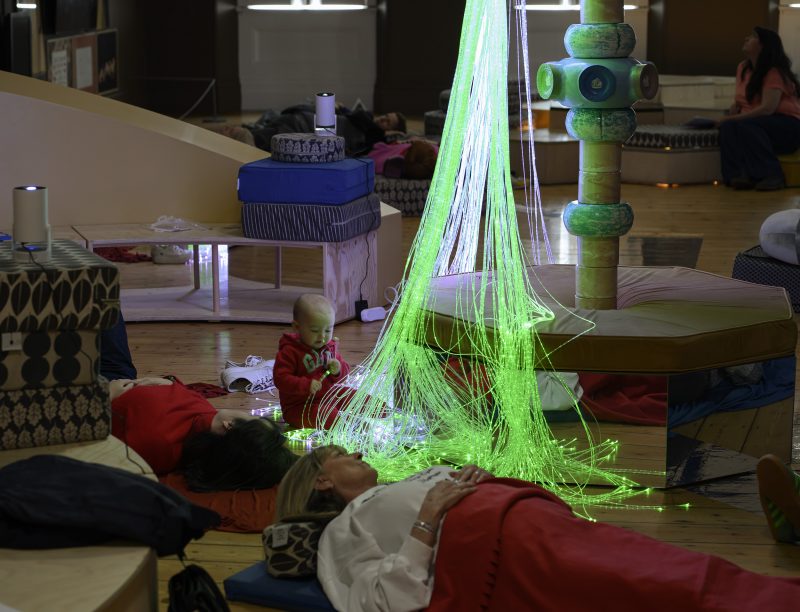
In May we lay in the art gallery with the shutters shut, the lights low. Plumped on cushions and snuggled in blankets we lay, a group of adults in the bright of day, in the strange excitement of a sleep over. Here the group were invited to close their eyes, let their minds wander whilst they were introduced to themes of sleep interlaced with the words of the lullaby above.
This lullaby was written by the renowned American folk singer Peggy Seeger in the late 1970s and recorded in 1980. It was chosen for the workshop specifically because it so beautifully captures the embodied work of getting a baby to sleep and the physical conditions of caring for a new baby. Unlike other lullabies that enter into narratives of dream-like sequences and fairy tales – When you wake you will have cake and ride them pretty little horses – this lullaby brings these tensions of care to the surface so that the song is not only soothing the baby into slumber but acknowledging the everyday heart ache and physical aches of motherhood perhaps adding a moment of comfort to the sung to and the singer.
In an intervention on sleep, Holly Pester asks – Who are the singers of lullabies? She says:
‘Lullaby singers are those who nurse, heal, craft and care, those who ‘invisibly’ produce the economy, infrastructure and ecology of the home.’ (Pester, p213)
In this sense the lullaby is a work song. She continues:
‘Like any shanty or marching chant the rhythms of her body and the tempo of the song – rocking and jigging the baby into slumber – co-ordinate the act of material effort (in the scene of supposedly immaterial labour). Here … the woman’s body performs as a resource to soothe and oil the mechanics of capital. This is care work shown for what it is, sweating, muscular movement-task.’ (Pester, p114)
A lullaby is a work song, because care is labour, even if that labour is hidden.
It must be hidden, so that those who undertake it can continue to be exploited by a system that relies on their unpaid labour. The labour of care is disguised by sentimentality, presented as a natural, biological imperative, and enforced by social expectation.
Nevertheless, there is an uneasy recognition that care is labour, and that labour, in a capitalist system, should only be performed for gain. If you willingly labour for longer than is demanded- this logic runs- then you are a fool, or you are being tricked. In this case, that you are being exploited by the direct beneficiary of your labour; your infant child.
We are told that the goal is autonomy, separateness; that the baby should learn to self-soothe, or be left to cry it out. That the child who is a good sleeper does so alone, in their own bed. We are told that the child must take on the labour of care for themselves as soon as possible, instead of giving and receiving it.
We are told that the parent mustn’t offer care-as-labour for too long, because then the child might continue to expect it. That the parent who continues to do so is making a rod for their own back, and that the child will become spoilt, soft, over-dependent.
The unspoken fear is perhaps that the child who receives care in the form of the lullaby-work-song, might remember it if it continues past babyhood and into their memory-forming years. That that child might continue to want to be cared for, and to care for others. Or that the parent who provides the labour of care might come to expect care in return.
In a system where care-as-labour is transactional, not reciprocal, we stop having a right to it as soon as we can perform it for ourselves, and in an individualist society, rights are what we use to ensure justice.
The alternative is a system that centres responsibilities, instead of rights; this is a central argument for the value of adopting an ethics of care over an ethics of justice. Care is still labour, but where it is acknowledged rather than hidden it can be seen, valued and shared, so both the effort and the benefit of that labour are collective. Carer and cared-for are not fixed roles, but an ongoing relational dance that a whole community performs together.
References
Pester, H. (2016) ‘Songs of Rest: An Intervention in the Complex Genre of the Lullaby’ In Callard F, Staines K, Wilkes J, (eds) The Restless Compendium: Interdisciplinary Investigations of Rest and Its Opposites. Palgrave MacMillan: UK, pp.113-118.