By Ruth Levene
Over a number of months, Abi Hackett, Jill Pluquailec, Ruth Churchill Dower and I have been sharing ideas, academic papers, artworks and practical experiments as a way to explore alternative framings for toddler languaging and communication. This has helped us move away from developmental frameworks towards a broader set of ideas and approaches.
We’ve talked a lot about how, as adults, we try to make sense of toddlers actions and communications and maybe inadvertently layer meaning onto them. The process led us to a series of invitations to think differently, which formed the basis of a workshop bringing together early years practitioners, community groups and academics.
During the research period I spent time, camera in hand, hanging out with and recording my friends’ toddlers, or in some cases giving the toddlers the camera. After each session I pulled out extracts that spoke to me and fed them back to the group, informing the conversation and ideas. I became interested in the different assumptions, methods and technologies by which early years practitioners and academics transcribe or make sense of toddler language. I learnt about multimodal systems and automated transcription tools.
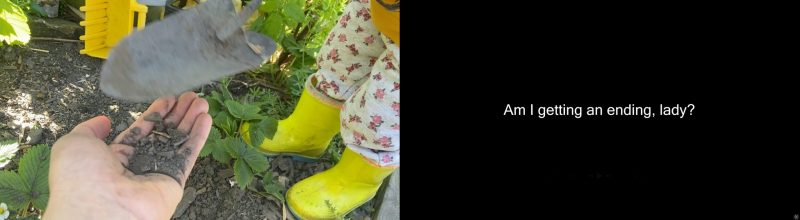
One fragment of an encounter between a toddler and myself kept coming up in the discussion. It was a sunny day, the birds were singing and the toddler was digging and playing in a bed of dirt in the garden. Happily chatting away, he gestured for me to put my hand out to receive his gift of dirt. “Diggin’ in the dirt, why?” is what I heard when I listened back to the recording, although others heard “Diggin’ in the dirt, wipe?”
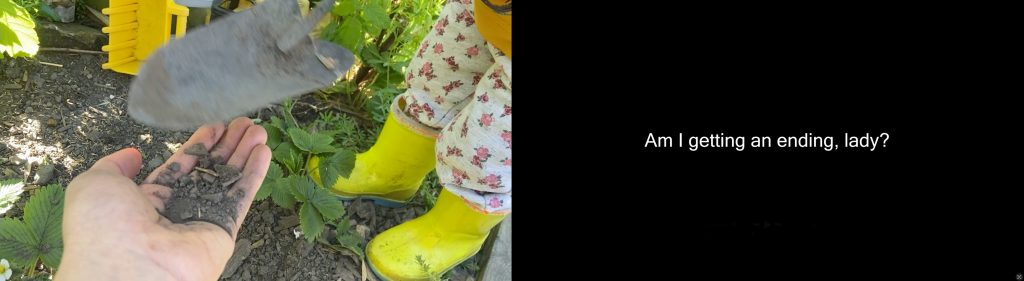
Image: Digging in the dirt with transcribe
For the workshop we decided to strip this recording down, exploring how different meanings would be made depending on how the fragments were ordered. The first was audio only, played on headphones. The second was the same audio, this time accompanied by words on a screen. Finally, the video of the encounter was presented, but without any sound. The words in the second viewing seemed loosely related to what was spoken, but quickly became nonsensical and ended up as a completely different language. They were generated directly in the editing software, Premiere Pro, which I had asked to interpret and transcribe what the toddler was saying using its AI transcription tool.
The three presentations gave us space to notice the assumptions we may make when listening to toddlers. They gave a window into the things we may miss, and the multiple layers that exist. Repetition offered a chance to rethink and re-understand the same moment. By the end, sense-making had been rendered as fluid, uncertain and in passing. How we arrive at it becomes just as important as the words we think we are hearing. The words and sounds uttered may be intertwined with the environment and the moment, or not. They may come from another place entirely, in time, space and imagination. They may be a result of the dance between sound maker and listener?
My practice as an artist explores the systems and infrastructures we have to navigate and exist in. How do we fit into them? How are we viewed and heard through them? How do we relate to each other within them? How do they shape us? What gets missed or buried when the fit is not right? How much friction, restriction, guidance and signposting is needed and whose should lead who? How much space is there for autonomy, uncertainty, risk and failure?
In this project I am beginning to wonder what the dance between adult and toddler would feel like if the current framings and narratives were shaken, softened and widened a little. It could be said, that both young children and artists are both driven by inquiry, curiosity and play as a way of not only making sense of the world, but also who they are in it. We both draw heavily on our intuition and inner guides, aligning and attuning body and mind.
From the point of view of the systems, artists and children (at least their process of being) inhabit the non-sensical, the inarticulate, the fleeting, the unresolved, the messy and the liminal. On the one hand our society admires that, but as an idea, not as a practice. Within the frameworks of the institutions that shape and mould us, our particular ways of making sense are being brought starkly into the firing line. The values and metrics of a technocratic, capitalist, reductionist and industrial system are at odds with artist and child play.
But maybe it’s easy to romanticise toddlers, children and artists, and to make assumptions about how we think and work. There are a number of artists working on the Toddlerhood project, each using different materials, methods and approaches – dance, sound, concepts, dialogue and research. Each of these methods, materials and ways of thinking has allowed for different framings, different forms of connection and different ways into the toddler world. It’s the diversity of ways of making sense, and of sense-making, that seems to me the one thing that makes sense!