Ruth Boycott Garnett
On the 12th of May 2026 we gathered in Manchester Art Gallery for the 4th workshop in the series on Toddlerhood. Here is a little account of the things we got up to and the different provocations that were set. The afternoon included an activity that you are welcome to try yourself if you find yourself in a gallery space and thinking about rest.
The session took place in the Things of the Least exhibition. This is an exhibition made specifically with under 3s paying attention to their material encounters and what this might mean for working with collections. The group for the day included the Towards Toddlerhood team alongside early childhood researchers, artists, practitioners and managers across visual arts, theatre and dance and early years settings.
We started the day in the studio with a short introduction from Rachel Holmes that laid out what knowledges the team hoped to encounter in the workshop – installation, poetic / lullaby, movement/stillness and art. These were intended to mobilise sensate, embodied knowledges of sleep and restfulness and to examine sleep within a frame of toddlerhood. The two central questions for the day were:
Why does sleep matter (in our re-thinking of toddlerhood)?
What else does sleep do for our re-thinking of toddlerhood?
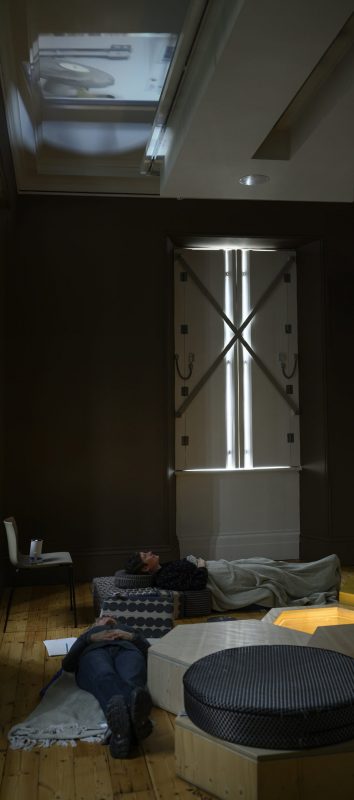
Following the introduction there was then an invitation from artist Anna Macdonald to enter the gallery space and experience her Sleep installation. Here the lights were low and individual nests of cushions and blankets were scattered across the floor. On the ceiling, ten small pools of projection offered images of numbers slowly counting down. Everyone settled into their own bed and the films above them began to play.
As the film continued there was a stillness in the room, soft breaths as individuals relaxed into their space on the floor. Some eyes were closed whilst others were fixed on the ceiling as a mixture of motions and images created a dreamlike sequence above them.
As the film came to an end the group were introduced to themes of sleep and sleepiness in an academic lullaby. This was created from a mixture of research and song to introduce four themes of sleep. These themes constructed sleep as:
- A politics of care – who gets to rest? Who must stay awake? Links to feminism, labour, marginalisation.
- A site of vulnerability – sleeping bodies cannot defend or perform—they are exposed, watched, controlled.
- A resistance to productivity – sleep interrupts capitalism—but is also increasingly captured, measured, optimised.
- A boundary state – sleep traverses divisive notions of: conscious/unconscious; mind/body; self/other; life/death.
After the lullaby, the shutters of the gallery were opened to let in natural light, and everyone was invited to write their reflections before joining in small groups discussions.
During the discussion participants were invited to draw on an assemblage of their own sleeping habits and experiences of sleep as a parent and as a professional mixed with the film and lullaby to re-turn their thoughts, feelings and affects towards:
Why does sleep matter?
What else does sleep do?
After lunch Abi Hackett gave an overview of the Towards Toddlerhood project introducing the project team and the themes that have emerged across the seminars so far. Rachel Holmes then led us in a full group discussion on the four themes of sleep introduced in the morning session and how these themes influence the two central questions before introducing the main activity for the afternoon.
Finding Rest in the Gallery
This activity was held not just within the TotL exhibition but within the whole gallery so participants were invited to explore the whole building with particular ways of looking in mind. The instructions are included here in case you would like to try out this activity in a gallery near you. Just as the ceiling films had asked those in the space to look up, to soften their focus and to give up control of their posture, the activity included here intended to keep working inside that logic.
Instructions:
Walk around the gallery spotting sleep-related images or affects that tie with our 4 categories of sleep outlined above.
Throughout the wander around the galleries engage in:
Non-productive looking (drifting attention)
Off-balance bodies (not upright, not efficient)
Peripheral vision (instead of focused viewing)
Find:
An artwork that feels like rest
An artwork that feels like it prevents rest
A place where you could almost fall asleep
A place where sleep would feel forbidden
The activity then included a series of prompts. These are listed below:
Drifting – stand in front of a piece of art that attracts you and try drifting your attention – you don’t need to understand anything, let your gaze blur, listen to distant sounds more than nearby ones, follow something minor (a shadow, a corner, a texture).
Prompt: What becomes visible when you stop trying to focus? (Sleep as boundary state)
Bodies – notice where your body feels (un)supported, notice where it feels exposed, shift position: lie down, sit, lean, crouch (within what’s possible). Did lying down feel comfortable? For everyone? Did anyone feel exposed, watched, out of place?
Prompt: How does the same position that invites rest can also produce risk? (Sleep as a site of vulnerability)
Witnessing – Sit, lean, hover, or linger or stay longer than feels socially acceptable in one place/space. Notice when you feel visible, notice when you disappear into the space.
Prompt: Who is this space comfortable for? Who must stay alert? Where is rest allowed? Where is it policed? (Sleep as a resistance to productivity)
After this activity the group gathered to reflect on their experiences in the gallery and across the day of activities before the team brought the day to a close.
Image Credit: Andrew Brooks