By Sid Mohandas
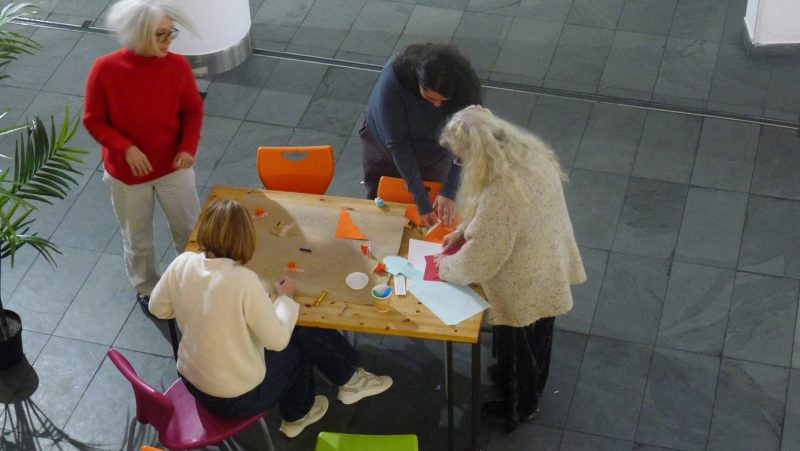
The Towards Toddlerhood workshop took place at the ArtsDepot in North Finchley, where we gathered in one of the studio rooms right beside the PlayDepot. The theme of this workshop was tantruming. In line with the wider aim of the project, the full day workshop sought to move away from developmentalist framing of toddlerhood and tantrums, to re-framing them as artful, relational, embodied, and more-than-human.
The workshop was attended by people from many different backgrounds, early childhood
practitioners, scholars, artists, many of whom were encountering more-than-human perspectives for the first time.
Professor Abigail Hackett, who is the lead researcher of the project, situated the workshop within the wider aims of the research. The rest of the session was facilitated by Professor Jayne Osgood, Professor Victoria de Rijke, and Seo Hye Lee. Jayne and Victoria started their presentation with a paper they had written together titled ‘That’s enough!’ (But it wasn’t): The generative possibilities of attuning to what else a tantrum can do. The children’s book Angry Arthur, which the paper drew from, was at the very heart of the workshop. We began with a reading of the book, which immediately set the affective tone in the room, bringing to the fore
tantruming as a transversal force that works across boundaries and scales.
Alongside Jayne and Victoria was Seo Hye Lee, a deaf sound artist whose work experimented with sounds and vibrations. Through low frequencies, resonances and bodily vibrations, we were invited to experience how sound moves through us, how it agitates, comforts, overwhelms, and transforms. From discussions that followed it was clear that the sounds and vibrations were felt variously by the participants. This particularly resonated with me as an autistic with bilateral hearing loss, who increasingly experiences the world through muffled sounds and bodily vibrations. While in the classroom, the atmospheric soundscape is experienced as a sensory accumulation on the bodymind that does not parse the various sounds and vibrations into discrete categories. Wearing the hearing aids amplifies all those micro-sonic textures of the environment that would otherwise elude the bodymind, but even without them, the parsing of sounds and vibrations seem impossible. And I’m often exhausted at the end of the day.
Erin Manning (2012) describes this pre-parsed, relational mode of awareness as ‘autistic perception’. Autistic perception according to Manning (2024, p.80) is ‘a modality of perception amongst autistics that slowed the configuration of the world into categories’. I would argue this modality of perception is characteristic of babyhood and toddlerhood. Read through autistic perception, tantruming can be understood as an affective intensification that emerges from the accumulation of sensory forces, rather than as an individual behavioural outburst. It becomes a transversal force that moves atmospherically across bodies, i.e. forces that work on the ‘tantruming child’, as well as on and across other entangled bodies (human and nonhuman alike). Working in consonance with Jayne and Victoria’s research, Seo Hye’s installation conveyed tantruming as a more dispersed phenomenon, than being located within the bounded individual child.
In most early years settings, ‘behaviour management’ sits at the heart of everyday practice. ‘Tantrums’ are often framed as failures of regulation, treated as something to be controlled, reduced, redirected, or trained away. The goal is usually calmness, compliance, and quick resolution. Words like ‘self-regulation’ and ‘co-regulation’ are currently buzz words in early years, as evidenced in this Nursery World article (published only few days after the workshop), which while seeking to reframe ‘tantrums’ in a more positive light, continues to work within the confines of developmentalism, offering tips on how to help children develop the self-regulation skills. Tantrums become unwanted interruptions to the smooth running of the day, something children are expected to “grow out of”. The workshop offered us four lines of provocations: What else is a tantrum? What else does a tantrum do? How does a tantrum feel? How is a tantrum (always) more-than-human?
What really resonated with me was the reframing of tantrums as a form of activism. Activism at
its core says ‘I refuse to accept these conditions! I demand another world!’. Tantruming could be
seen as a refusal of conditions that we find ourselves… too loud, too fast, too restrictive, too
overwhelming, too unjust. Seeing tantruming through this lens reframes it as a powerful
phenomenon of reorienting and reorganising worlds. Sara Ahmed (2025) in her latest book “No
is Not a Lonely Utterance: The Art and Activism of Complaining’ pushes against the idea that
refusal is merely an individual reaction, instead she argues that it emerges from conditions,
histories, and worlds bodies are forced to live within. What is really interesting to me is the
insights tantruming aka (child) activism offers us in reimagining how we see activism and what it
does.
The workshop didn’t offer techniques to stop tantrums. Instead, it offered a different stance that
is ethical and relational: one that asks us to slow down, notice what else is at stake in the
phenomenon of tantruming.
References
Ahmed, S. (2025) No is Not a Lonely Utterance: The Art and Activism of Complaining. London:
Penguin Random House
Lee, S. (n.d.). Seo Hye Lee. Retrieved January 31, 2026, from https://www.seohyelee.com
Manning, E. (2012). Always more than one: Individuation’s dance. Duke University Press.
Manning, E. (2024). Exploring autistic perception in architecture (Interview with T. S. Heiredal).
Architectural Research Quarterly, 28(1), 79–103. doi:10.1017/S1359135525000041
Osgood, J., & de Rijke, V. (2022). ‘That’s enough!’ (But it wasn’t): The generative possibilities of
attuning to what else a tantrum can do. Global Studies of Childhood, 12(3), 235-248.
https://doi.org/10.1177/20436106221117167