Seo Hye Lee
I’ve been thinking back to the tantrumming workshop while staying out of the rain in a particularly stormy corner of Somerset. The weather has been doing its own work, constant, insistent, difficult to ignore, and it feels like an appropriate backdrop for returning to a day that was less about explanation, and more about staying with sensation.
The workshop included two sound moments. Neither was introduced as something to analyse or interpret. Instead, they were framed as situations to spend time inside.
The first sound piece began slowly, played directly from a portable speaker into the room. It was made up of a series of sustained tones rather than melody or rhythm, shifting gradually in texture and density. The duration of these tones was intentional. The sound stayed long enough for initial reactions to pass, for attention to wander and return, for bodies to settle or resist settling. It required patience rather than comprehension, a type of listening that wasn’t about clarity, but about something more akin to endurance, an exploration of listening (maybe even of patience and resisting the urge to move).
You can listen to the first sound piece here (you made need to create a free soundcloud account first!).
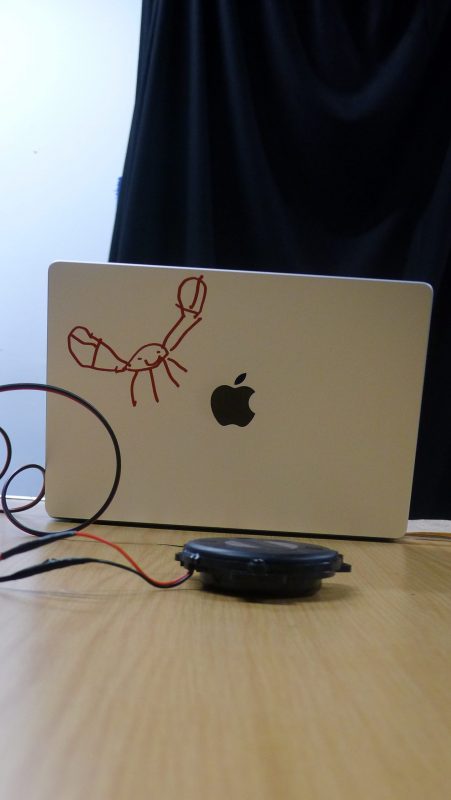
The second sound moment focused on vibration. Low frequencies travelled through a shared surface rather than through the air, asking participants to move closer if they wanted to feel more. Again, duration was key, with the vibration persisting over time rather than peaking and releasing. Gradually, people adjusted their bodies in small ways, leaning in, pulling back slightly, placing hands on the table, shifting weight. What emerged wasn’t a performance, but a collective negotiation of proximity.
You listen listen to the second sound piece here.
What stayed with me most, though, was what happened after the sound stopped. Particularly during the vibration session, when the low frequencies finally faded, there was a noticeable hesitation. People seemed unsure whether to stay close, to pull away, or simply to wait, or look directly at me or towards others. The end of the sound didn’t resolve the situation; it produced a small pause where no one quite knew what the “right” next move was. Some stayed longer than expected, as if listening for something that might return. Others withdrew more quickly, but gently, without urgency.
That pause felt important.
It echoed many of the ways we’ve been thinking about tantrumming, not as an explosive event, but as something that exceeds neat beginnings and endings. The sound wasn’t asking to be interpreted while it was happening; its effects became more visible in the aftermath, in the subtle negotiations of distance, attention, and care. What lingered wasn’t sonic exactly, but relational.
Working from a d/Deaf perspective, this is something that is particularly interesting to me, as I always think of listening as something that doesn’t end when sound does. During the workshop, listening seemed to shift registers once the vibration stopped, into waiting, uncertainty, and choice. In that sense, the work didn’t conclude cleanly. It lingered, quietly, long enough to interrupt habits of smooth transition.
I’m still sitting with what that pause held, with tantrumming understood less as an outburst, and more as persistence, residue, and a demand to be felt rather than fixed. In this sense, thinking about tantrumming alongside activism feels useful not because tantrums make arguments, but because they insist: on attention, on proximity, on response. It feels less like something to conclude, and more like something to keep listening to, even after the sound has faded.