Christina MacRae
At the end of the day, Ruth and Abi invited us to respond to the activities, conversations and presentations using the materials on the table. It took me a long time to turn this task over and explore the food stuff on the table and other materials on offer. I often find it hard in these situations to allow the materials lead me: my natural inclination is to have an idea that I then use materials to represent, and it’s hard for me to let other forms of response emerge.
I tried to push the thoughts I already had away and keep focussed on the materials on the table. I found myself being drawn to the white bread in its plastic cover. I become conscious that faced with the fruit on the table I had another niggle about creating an artefact that was in the making wasted food that could be eaten. My thoughts returned to an earlier conversation with another participant about why we focus our anxieties so particularly on wasting food, when there are so many other resources that we waste. I mused that the white bread likely had little more nutritional content than cardboard – and how strange it was that I felt so uneasy to ‘waste’ the bread by playing with it.
I couldn’t quite shake this feeling off, so this led me to choose the end part of the bread as I know this part is often discarded as it is all crust. As soon as I started to pull out the spongy bread in my fingers, memories of food play as a child came back to me. I remembered a strange ritual I had when I was very young when eating chicken: I’d break it into smaller pieces and enjoy the strange way it could feel sticky against my teeth as I opened and shut my teeth biting down and un-biting. I remembered consciously biting into the chicken pieces slowly – not to chew the food to swallow, but rather to increase an odd feeling that my teeth were momentarily stuck together – and the internal squeak and release when the teeth opened from the bite. I would push a few pieces of chicken to the edge of my plate to save them until last.
At the same time as these thoughts interrupted me, I was fingering the doughy bread and aware how it was almost like a play dough and something I could mould. I found myself thinking of still life paintings of bowls of fruit, and tinged with this image was also a thought about 5-a-day healthy eating messaging.
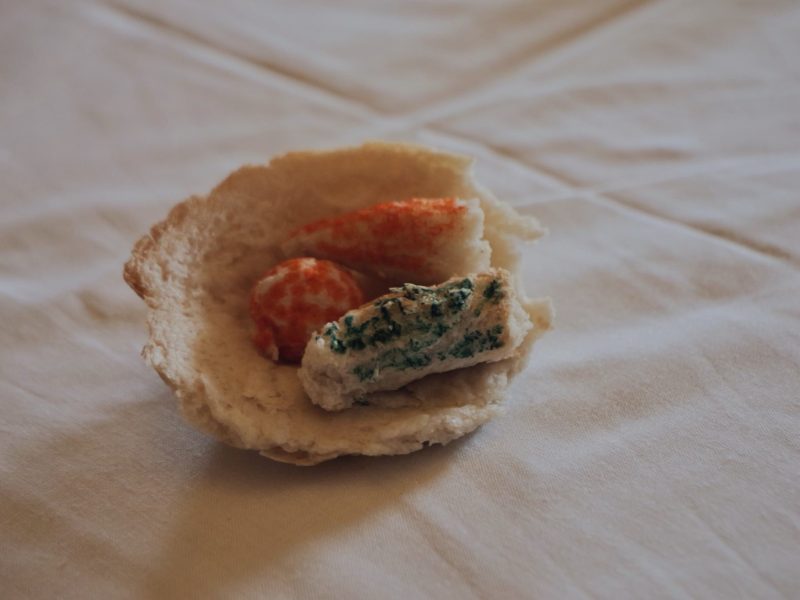
I kneaded out a bowl from the bread dough and then rolled a ball as there was an orange felt pen, and the ball became an orange. I rolled another piece of dough to make a carrot shape; then another roll that I made green – healthy vegetables in a bowl. I wanted to get my 2 more vegetables made to make five, but I ran out of time.
A few days later there was an article in the newspaper about the microplastics that are contained in school uniforms and that are inhaled by children. Most school uniforms “are made from polyester, the synthetic, petroleum-derived fibre”*. When washed they release microplastics: these are “are particularly hard to remove from the environment and are easily ingested by organisms across the food chain.”* My niggles both about healthy eating messages and waste came back into play: what is waste, and what is wasteful become even more confused. I start to wonder what is food? We consciously eat certain kinds of ‘healthy’ food, we feel good and even more when our children eat it, but at the same time what else are we eating, drinking and breathing without meaning to? “People cannot stop breathing, so even if you change your eating habits you will still inhale them [microplastics]” **
*https://www.theguardian.com/environment/2025/sep/06/what-is-in-childrens-school-uniforms?CMP=Share_iOSApp_Other
**https://www.straitstimes.com/world/theyre-everywhere-microplastics-in-oceans-air-and-human-body