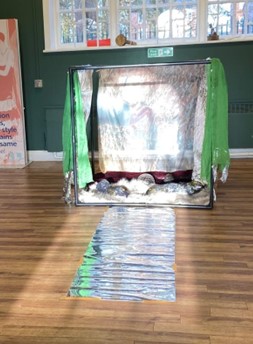
by Kitty Winter and Christina MacRae. Image by Naomi Kendrick.
In December 2025, Kitty (dance practitioner) and Christina (early childhood researcher) joined four stay and play sessions at Platt Hall in Manchester, hosted by Manchester Art Gallery, and led by Sure Start outreach workers, with materials and play provocations curated by artist Naomi Kendrick. We wanted to explore ways that we might be able to (re)cognise the capacities of toddlers as already-dancers and already-artful. The sessions (one in the morning and one in the afternoon), were attended by preschool children and babies with their parents and carers. In the first two sessions we watched, talked to children, carers and practitioners, and joined in with the play, following the children’s lead. In the second two sessions Kitty offered an experimental ‘game’ that ran through the open play section of the session. She also invited adults to respond to what took place using a tool for shared reflection at the end, after the families had come together for songs and snacks.
Tiny Dancers Game:
In the second two sessions, at the start, Kitty let us know that at moments throughout the session she would play some music, sometimes a complete song or track, sometimes a short extract.
Kitty told adults accompanying their children that they would be joined by some exceptional dancers who have come to perform for us. These dancers, she explained, are their children. This set-up served multiple functions; it drew the adults into a state of game-playing by pretending their children were skilful dance artists; it elevated the children’s status and conferred significance to their movement responses to the music. It also provided a slight de-familiarising effect to encourage adults to notice their child’s movement in non-quotidian ways.
When the music played, she invited the adults to:
- Just notice their tiny dancer
- Follow their tiny dancer’s lead and duet together
- Dance themselves in response to the music and their tiny dancer
She asked the adults not to prompt the children to dance or encourage them to copy an adult’s way of dancing: the children were the experts in their own movement. The principle of the game is to notice, value and enjoy the movement that children do spontaneously when music is playing. The movement may be clearly connected with the music in terms of rhythm, energy or emotional feel, so that it is instantly recognisable as ‘dancing’. Or it might be something else; children might be still and listen, watch others moving, or ignore the music altogether. The music that Kitty had selected did not include anything specifically intended for young children, but rather, was chosen for its danceability.
Un-defining dance: reconceptualising toddlers as already-dancers:
Kitty’s starting premise is that dance need not be codified, set or intrinsically tied to music, but can instead consist of any combination of movement and stillness. This definition, or perhaps un-definition, of dance is widely understood and accepted within the field of western contemporary dance. Choreographer Barbara McAlister, writing about a recent project using playground games as a choreographic tool, notes that “the experience of play [is] enough, no transfiguration necessary… dance is not defined by the external but is defined by the internal – it is a state of being” (2022, p. 15). Considered in this light, young children are prolific and committed dancemakers, using their bodies to explore movement for its own sake through game-play.
Not all movement is dance however: a defining characteristic of dance as an artmaking practice is that it communicates from one body to another, operating within a “dancer-observer dyad” (Orgs, Caspersen and Haggard, 2016, p. 4). The most deliberate incarnation of this relationship is the onstage performer and the watching audience in a conventional performance, but it can be seen clearly elsewhere. In a social setting where dance is expected, like a nightclub or a wedding, the roles of dancer and observer are fluid and may be taken on simultaneously as bodies dance together. The dyad can even be held within a single body – whenever someone chooses to dance, then they are dancing. In the stay and play sessions at Platt Hall, there was no stage and audience separation, and no expectation of dance encoded within the space, as there might be if the session were held in a dance studio, for example. The dancer/observer dyad was being activated solely by the adults choosing to view the children’s movement as dancing whenever the music played.
Artful Noticings
In the final part of the session after participants were gathered for shared fruit and ending rituals, Kitty invited all the adults (and children) to take part in a ‘disciplined’ noticing task. The following sentence starters are written on large pieces of paper, with writing materials for people to add their responses:
- I saw…
- I heard…
- I felt… (which can be interpreted as both tactile and emotional responses)
- I enjoyed…
These are prompts Kitty uses to encourage immediate, personal and sensory-led feedback in her practice of interdisciplinary physical performer training. The first-person phrasing acknowledges the singularity of all art experiences and removes any pressure to analyse or pass judgement on them. Drawn, written and spoken responses are all invited, and the framework creates conditions for noticing sensitivities that include sensory, emotional and pleasurable experiences.
Both the game and the writing task are informed by research theorist John Mason’s methodology of disciplined noticing (2002). Mason proposes that researchers/practitioners can systematically train themselves to notice specific experiences, habits or choices as they occur, to be able to act on them in a more intentional way. Mason suggests we “can only notice what [we are] primed or sensitised to notice” (ibid, p.66). Kitty’s invitation to notice-the-artful primes adults to notice the expressive qualities and embodied impulses of their children’s movement, and to capture what they notice through this series of guiding questions.
Christina, who would usually write observation ‘fieldnotes’ after a session, instead, took up Kitty’s invitation to notice artfully using the 4 prompts. This is what Christina saw, enjoyed, felt, and heard.
- I saw: the way that baby L was able to lock a gaze with me across the circle at the end (even though we were at opposite ends) and follow my body as I moved from side to side
- I saw: M drawing lines and outlines on the paper that was rolled out on the floor. I started to try and draw his lines after him, copying his marks. He noticed what I was doing and a game began. M drawing new lines, then watching my drawn response.
- I saw: Babies not yet sitting themselves were being held in sitting positions completely absorbed in watching the room and its moving bodies – there were no crying babies in the sessions
- I heard: the artful way that Liz (the children’s Centre practitioner) pitched and timed her singing the ‘I roll the ball’ song verses
- I heard: I was fascinated how L. was so absorbed in the tower building and ball-posting that he did not seem to hear the music at all, but that at the same his sister put her fingers on her ears and from the expression of her face it was clear the music was loud and too much for her…
- I felt: delighted by the drawing duet with M: it was completely unexpected, just like the dancing duet that I became part of with A.. Unlike the dance duet where A. looked at me intently, in the drawing duet M did not look at my face or have eye contact, they just intently looked at the lines being produced by each of us and sometimes nodding or shaking their head
- I felt: uncomfortable about asking parents/practitioners to fill out consent forms, but asking for the artful noticings on paper felt comfortable and conversational.
- I enjoyed: the dance of looks between the watching babies, and how often their attention was drawn to the moving bodies of feet-mobile others
- I enjoyed: the time that I started to dance in response to A.’s dancing. It was lovely to duet with such an enthusiastic dancer. At first, I attempted to imitate his dance moves; but there came a special moment where it became hard to know who was leading and who was following as he was also picking up my gestures.
- I enjoyed: the way that parents responded to Kitty’s invitation to write on the paper at the end, and how some children also made marks. This became another opportunity for M. to initiate another drawing duet from me. I realised that ending this way was different to the usual more definite end to the session, but I enjoyed the chatting between parents and how they lingered.
- I enjoyed: the pleasure A.s mum took in explaining that in their house they often all dance together in the kitchen – telling me the music was sometimes Arabic and sometimes European popular music: how as soon as the children hear the music coming up from the kitchen, they leave their rooms and screens and come to dance.
Producing responses to tiny dancers through the medium of Kitty’s four ‘noticing’ questions seemed to have the effect of opening up a more generous and ‘artfully’ inflected form of observation, in contrast to more prevailing ‘developmental’ frameworks that early care and education is so steeped in. For parents, carers and practitioners, responding to the tiny dancers through the lens of an artful framing resisted the gravitational pull of ages/stages expectations, and early childhood assessments where making judgements about children’s ‘progress’ and achievements tinge perception. Similarly for Christina, as researcher, these simple directives for noticing acted to unsettle some of her habitual attempts at writing fieldnotes, which also carry their own gravitational pull towards detached records that tell us ‘what took place’.
Conversations after the sessions: Christina, Kitty and Abi
Christina: I was struck how the simple device of organising my noticings prompted by Kitty’s four questions allowed me to produce a different kind of ‘fieldnotes’ to those I still tend to produce despite long-held feelings of dis-comfort and deadening that they instil. I find myself lapsing into default ethnographic fieldnote practices of generating ‘data’. For me, this struggle goes back many years and it’s one that I have previously written about with colleagues (Jones et al, 2010). However hard I try to document otherwise, I fall into writing myself out of the fieldnotes, and then trying to put myself back in, after the event. Kitty’s anchor prompts for noticing helped to open up, more boldly, a space to write from my thinking-feeling-body at the start, and to focus on the things that drew me in; things that made me hesitate; or feel pleasure.
Kitty: I am interested in an ontological viewpoint where art is created in the relationship between artist, artwork and spectator. This idea is expressed, for example, in Peggy Phelan’s writing on the ephemeral nature of performance (2006), and in Christopher Small’s concept of ‘musicking’(1999). The artmaking in the Tiny Dancers Game lies in the relationship between the moving and the watching; by inviting adults to frame the children’s movement as dance whenever there is music playing, without imposing any expectations about what dancing should look like
Christina: When I danced with A. I felt like I got to the place where it was not clear who was leading and who was following much more quickly than I had when we had taken part in an all-adult movement game led by Anna Macdonald in our first Towards Toddlerhood network meeting. It has made me think about movement as a language that we, as adults, have in common with children: so maybe it’s easier to be on a more equal footing quite literally? This couldn’t have happened if we had used words because speech is a language where I have the advantage of fluency. The next day, my aching muscles from dancing made me laugh – I am sure A did not have this bodily reminder of yesterday’s dancing, revealing a proficiency that I lacked.
I also thought more about how I had noticed many babies in the sessions were not necessarily responding to movement with their bodies, but they were nevertheless, engaged in an intense watching of the movement going on in the room. I started to think about the dance of looks and gazes. The intensity of watching reminded me of cats looking out of windows – attending to the smallest of movements and change. It is a kind of watching that I think I do much more rarely as an adult.
Abi: The Towards Toddlerhood project asks: ‘how can arts practice generate critical conversations with, and alternative understandings of, toddlerhood?’. I am interested in the way you invited parents to notice the ‘artful’. I think these questions might be helpful ones as prompts for parents who are co-researching through photographs of everyday moments with me in the play group I am attending.
Kitty: Thinking about the photographs that Abi is currently inviting parents to take in a playgroup through the framing of artful noticing makes me think that the subject and composition of the photographs is less important than the intention behind taking them – that the artmaking in Abi’s collaborative playgroup research is about the families noticing and intentionally capturing moments from their young children’s everyday lives. Abi’s phrase ‘artful noticing’ describes the reframing of adult attention to view young children’s actions and experiences through the lens of artmaking. The very brief intervention that Christina and I ran at the Platt Hall stay and play can be framed as an exploration of ‘artful noticing,’ using dance as the frame through which to see and celebrate toddlers’ lived experience of movement.
References:
Jones, L., Holmes, R., Macrae, C., & Maclure, M. (2010). Documenting classroom life: how can I write about what I am seeing? Qualitative Research, 10(4), 479–491. https://doi.org/10.1177/1468794110366814
Mason, J. (2002) Researching your own practice: The discipline of noticing. 1st edn. London: RoutledgeFalmer. Available at: https://ebookcentral.proquest.com/lib/dmu/reader.action?docID=167124&ppg=16.
McAlister, B. (2022) ‘When Are We Not Dancing? Play and Experiencing Our Being as Dance.’, National Dance Society Journal, 7(1), pp. 15–25.
Orgs, G., Caspersen, D. and Haggard, P. (2016) ‘You move, I watch, it matters: Aesthetic Communication in Dance’, in Shared Representations: Sensorimotor Foundations of Social Life. Cambridge: Cambridge University Press (Cambridge Social Neuroscience), pp. 627–654.
Phelan, P. (2006) Unmarked: the politics of performance. digital print. London: Routledge.
Small, C. (1999) ‘Musicking — the meanings of performing and listening. A lecture’, Music Education Research, 1(1), pp. 9–22.