By Ruthie Boycott-Garnett
Last week I participated in the Towards Toddlerhood workshop at Arts Depot in London focusing on tantrums and the artwork of sound artist Seo Hye Lee. Seo Hye placed the speaker on the table and a long low sound filled the room.
At first I was enveloped in comfort – a hug of vibration that sparked cosy memories of (1) sitting near an old family friend who sang with a voice so deep you could feel the vibrations travel through the ground and make the chair shake. And (2) remembering the comfort that my baby son found in the low voices of family and friends – how he would curl with his ear resting on their chest and be lulled to sleep by low conversation. The comfort of deep.
The long sound would sometimes stop, a sudden break of momentary silence, then start again but with something changed, perhaps the new note was slightly higher or lower than the last. The vibrations were no longer a surrounding hug but had found their way into my body, into my chest and persisted so that I was no longer clouded in my own thoughts but very much in the room. I had to keep my eyes open and turn my attention outwards to prevent this persistent buzz in my chest from consuming me. Ana Minozzo, in a book on anxiety as vibration, talks about ‘vibrational moments’ where anxiety moves you ‘away from an abyss-within into a horizon-beyond oneself’ (Minozzo, 2024, p3).
As the sound played everyone was so still. Surrounded by unseen movement. Though there had not been specific instructions on what to do while the sound played it was as if the sound had made us still – taken all the movement of the room and condensed it into an intense stillness.
The week after, I went roller skating (co-incidentally, my learning to roller skate is a direct unexpected outcome of the towards toddlerhood project but perhaps that is a story for another time). I hadn’t skated for a long time, and after a busy day I put my skates on and feared falling. My body was super tense and I could feel every vibration and discomfort in my bones even from the smooth sports hall floor. It took me back to the vibrations in the workshop, the intensity and discomfort that seeped over my body. But as I relaxed into it everything became smoother, I travelled faster than I had before and I had a sudden realisation that the vibrations were the result of my attempt to keep my body separate from the rest of the world – that I had to keep myself somehow separate from the floor because then it couldn’t hurt me. But by relaxing into the motion and vibration of wheels on linoleum, the skates were an extension of my feet, the floor was something to wade through, not skirt above, and for a moment everything made sense.
Tantrums can feel like a vibration – in the body, and in the ripples that it creates. The provocation of thinking with tantrums as and/or through vibrations felt present in the
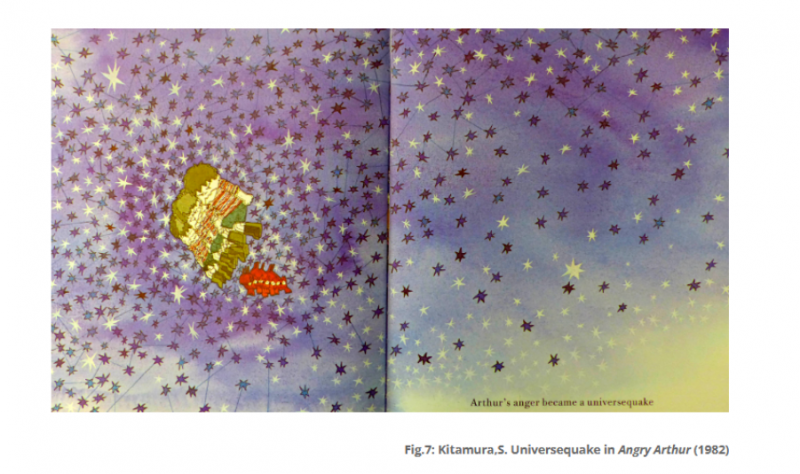
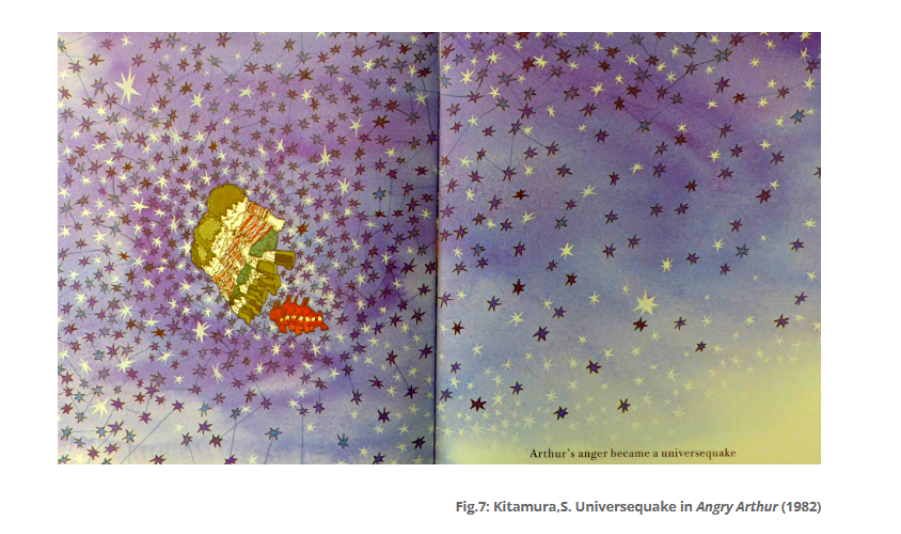
workshops, not just from the sound experiment and installation but also in the telling of Angry Arthur by Hiawyn Oram (author) and Satoshi Kitamura (illustrator). A particular picture from the book has stayed with me where Arthur’s anger becomes a ‘universequake’ and his body appears many times, overlaid across each other, blurring the boundary of his body and the starry galaxy that surrounds him like a vibration.
The clarity of my revelation whilst skating is already muddy as I try to put it into words but I hold on to the idea that some tantrums are perhaps that moment where, for whatever reason, you are separate from the world, you become conscious of all the everyday vibrations that surround you and pass through your body and you fight it. Elizabeth Grozs talks about vibrations as “vectors of movement, radiating outward, vibrating through and around all objects or being dampened by them” (2008, p55). Perhaps this is why a small body, so closely entangled in the material world around them, becomes momentarily aware of this vibrational force and needs to lie down in the aisle in Morrissons until they are part of the world again.
Grosz Elizabeth (2008), Chaos, Territory, Art: Deleuze and the Framing of the Earth, New York: Columbia University Press.
Minozzo, Ana. (2024). Anxiety as Vibration: A Psychosocial Cartography. 10.1007/978-3-031-62856-6.