Anna Macdonald
I was invited into the Toddlerhood project as one of a group of artists helping to explore ‘what would an artful (rather than a developmental) childhood’ look like? I am a dance artist/scholar and I am interested in movement, time and progression. As someone who specialises in movement that doesn’t get anywhere (dance), the idea of how we might think about the movement of Toddlers in a way that resists development models was particularly interesting to me.
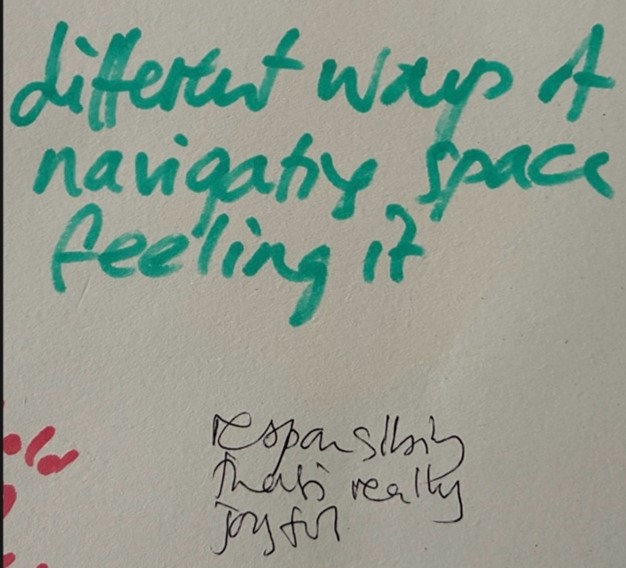
My part of the workshop took the form of what is referred to in dance as a somatic score. It involved a series of short invitations (see below), that invited participants to engage with different felt registers in the body – their sense of touch, perhaps or pressure or verticality. These prompts were intended to open up different ways of thinking about why Toddlers might move. The ‘why’ of movement, rather than the ‘what’, felt important in this space, because it acknowledges the situated, responsive complexity of all movement. It moves attention onto what Toddlers are doing rather than what they are not doing. It also starts some thinking about the benefits of staying where you are – of not progressing.
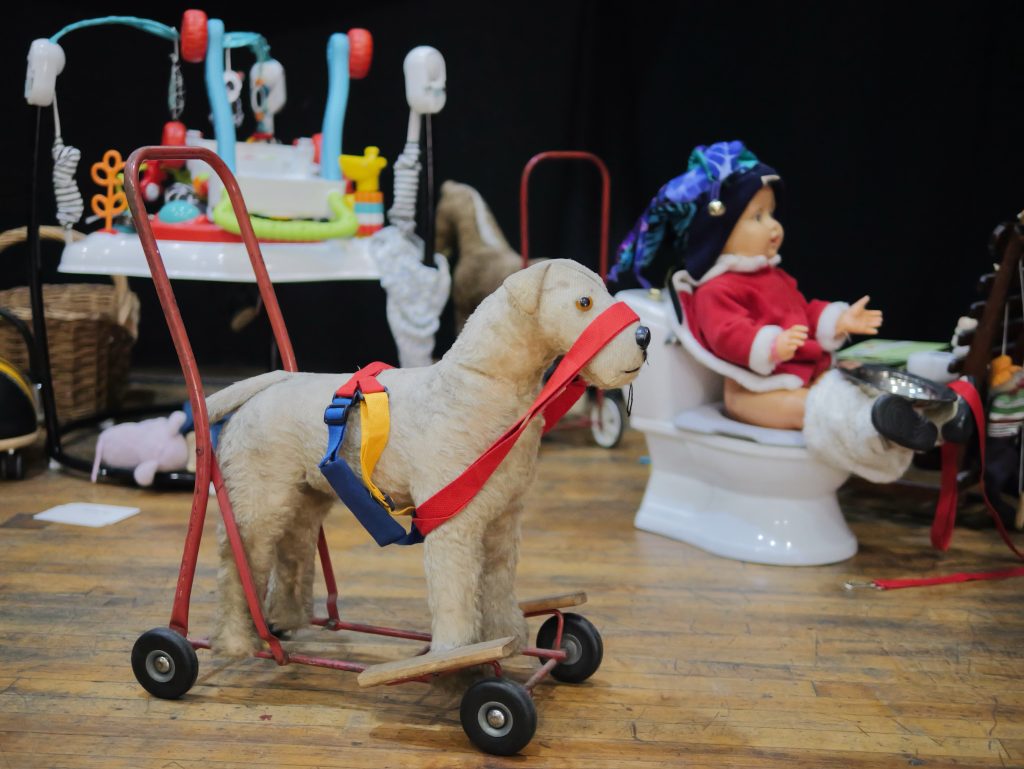
Before this workshop, everyone had been invited to encounter and arrange objects associated with babies, such as strollers, books, and muslin squares. Hence our movement began within a crowded floorspace, scattered with little clusters and arrangements of things (not unlike the floor of a home where a toddler lives). Starting not from a space that appears to be cleared for observation but from an in-the-middle, space of clutter, colour and texture, felt fitting. Observations of Toddler movement are often made out of context; an isolated infant body within an empty image frame. Movement amongst things/materials/ideas brings attention the relational quality of movement – we are always somewhere, focusing on something or someone through and with movement.
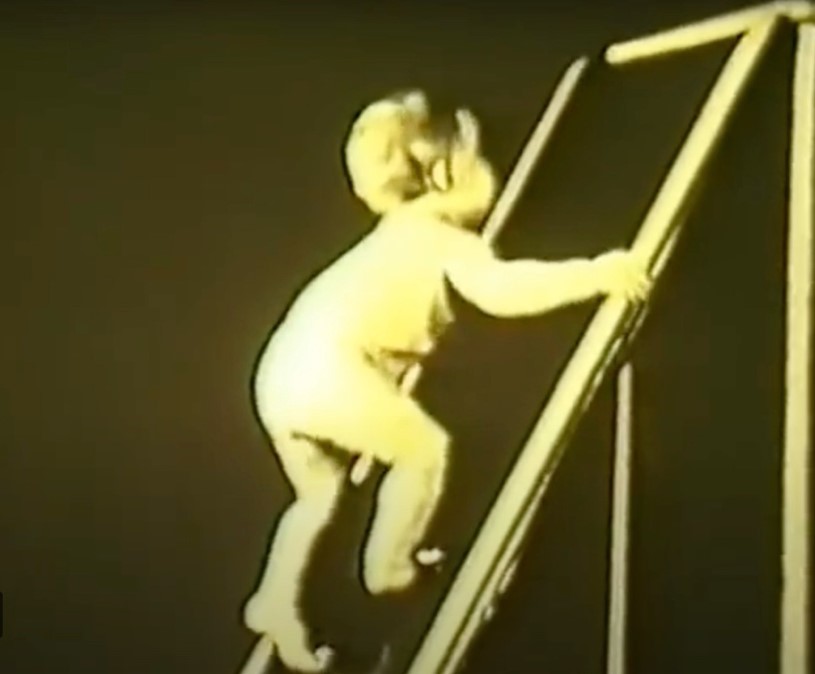
Film still at 5m 55 from Motor Development – Twin study of Johnny and Jimmy (1930-42) by Myrtle McGraw (1958)
Not getting anywhere – score
Macdonald (2025)
- Move whilst being aware of space. Get closer to things or further away from things. Move towards things that interest you. Notice when you see something else and move towards that. Be led by curiosity.
(I was struck by some advice on an early parental advice leaflet called “One and Two: there’s lots to do” from late 50’s/ early 60’s) – that reminded parents that maybe your baby is concentrating on something else. It’s deceptively simple and easy to forget that the child may not be aware they are meant to do things in a certain order by a certain time and that the relationship between interest, world and movement is key.
- Move towards or away from people – pass between people
There was a noticeable shift in the room as we experimented with this task: a mixture of play, awkwardness and nerves. I was reminded how large the shift from materials to people can be, and the effect other people have on the way we move.
- Keep equidistant apart
The group responded very positively to this task and spoke afterwards about how unusual it was not to be moving too anywhere, or moving productively, as we always tend to be in adult life.
- Let yourself be led with your eyes closed – two people either side of you.
Taking away sight reduces one of the ways we balance, and this was an invite to walk with less certainty. Amongst other things, this task aims to bring attention to our transitions – the spaces in between each foot finding its place on the floor.
Reflections
Experiencing and experimenting with these somatic scores, sparked discussion in the group about the small movements in between milestones such as the transition of weight from one foot to another or the places between sitting and standing.
How can we use art to re-see these in-between places as valued places in themselves?